Skip to comparison · Request a quote from Aurora
LED Work Lights For Excavators: Mount-By-Mount Comparison
| Mount location | Beam type | Recommended lumens | Critical spec | Aurora benchmark |
|---|---|---|---|---|
| Boom (front, near stick) | Flood + spot combo | 6,000-12,000 | Impact shock (bucket bite) | IP69K, 3-axis vibration, 10-60V |
| Counterweight (rear) | Flood | 4,000-8,000 | Slew vibration | IP69K, ISO 16750-3 |
| Cab roof (front) | Spot | 4,000-8,000 | Height clearance | IP69K, 22,000+ lm peak |
| Undercarriage (belly) | Wide flood | 3,000-6,000 | Mud + pressure wash | IP69K, 480h salt spray |
| Hydraulic side (service) | Spot | 2,000-4,000 | Oil fog resistance | IP69K, 50,000h lifespan |
| Travel motor (rear) | Flood | 2,000-4,000 | Travel vibration | IP69K, -40~+85°C |
Aurora benchmark: Every Aurora excavator work light is engineered to IP68 + IP69K, runs on 10-60V wide voltage (handles 12V mini-excavators and 24V large excavators equally), validated on a 3-axis vibration table per ISO 16750-3, and built with lot-traceable Osram/Luminus chips rated 50,000+ hours. A genuine LED work light manufacturer for the construction industry.
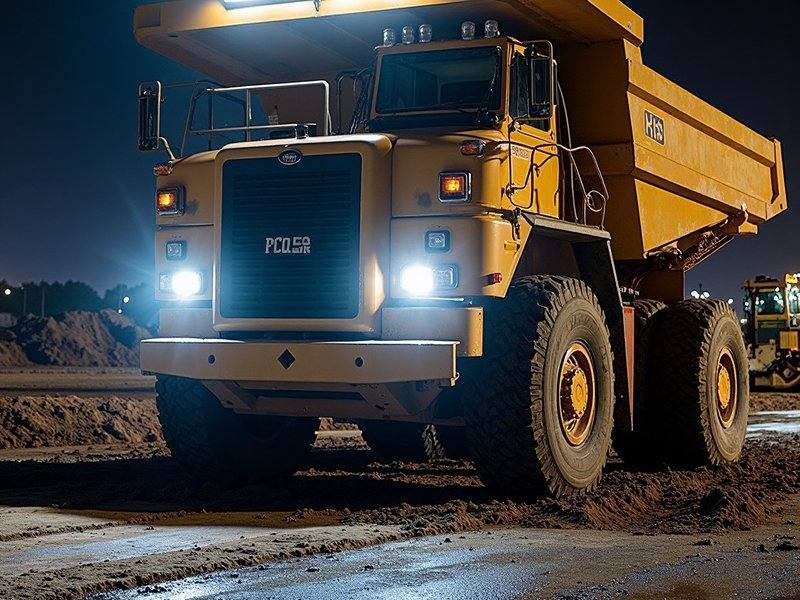
Why Excavators Are The Toughest Work Light Environment
The LED work lights for excavators decision starts with understanding what kills standard lights.
Boom Impact Shock
Every time the bucket bites into soil, rock, or concrete, the impact transmits through the stick to the boom — and to any light mounted on the boom. Peak shock can reach 15-25g for 5-15ms, repeated thousands of times per shift. A work light without mechanical shock validation (IEC 60068-2-27) cracks solder joints at the LED package within 200-500 hours.
Slew Vibration
Every swing of the house generates 1-5Hz torsional vibration through the counterweight and upper structure. This is low-frequency vibration that rubber isolators cannot dampen effectively — it requires tuned mass and stiff mounting. Lights on the counterweight see this continuously.
24V Electrical System With Load-Dump
Most excavators (CAT 320, Komatsu PC200, Hitachi ZX200, Volvo EC210 and larger) run 24V systems. The diesel engine alternator generates 60V load-dump transients when high-current circuits (hydraulic solenoids, swing motors) switch. A "24V only" work light dies within weeks from driver IC failure.
Mud, Hydraulic Oil, And Pressure Washing
Excavators work in mud, hydraulic oil fog, and dust — then get pressure-washed daily in the service yard. An IP68-only light leaks under the 100-bar, 80°C pressure jet. IP69K is the minimum excavator standard.
Cold-To-Hot Thermal Cycling
An excavator in northern winter operates at -40°C at start, +40°C by midday hydraulic warm-up, and may see +85°C near the engine compartment. This 125°C daily thermal cycle fatigues solder joints and gaskets. Aurora work lights are rated -40~+85°C operating, validated in a thermal cycle chamber.
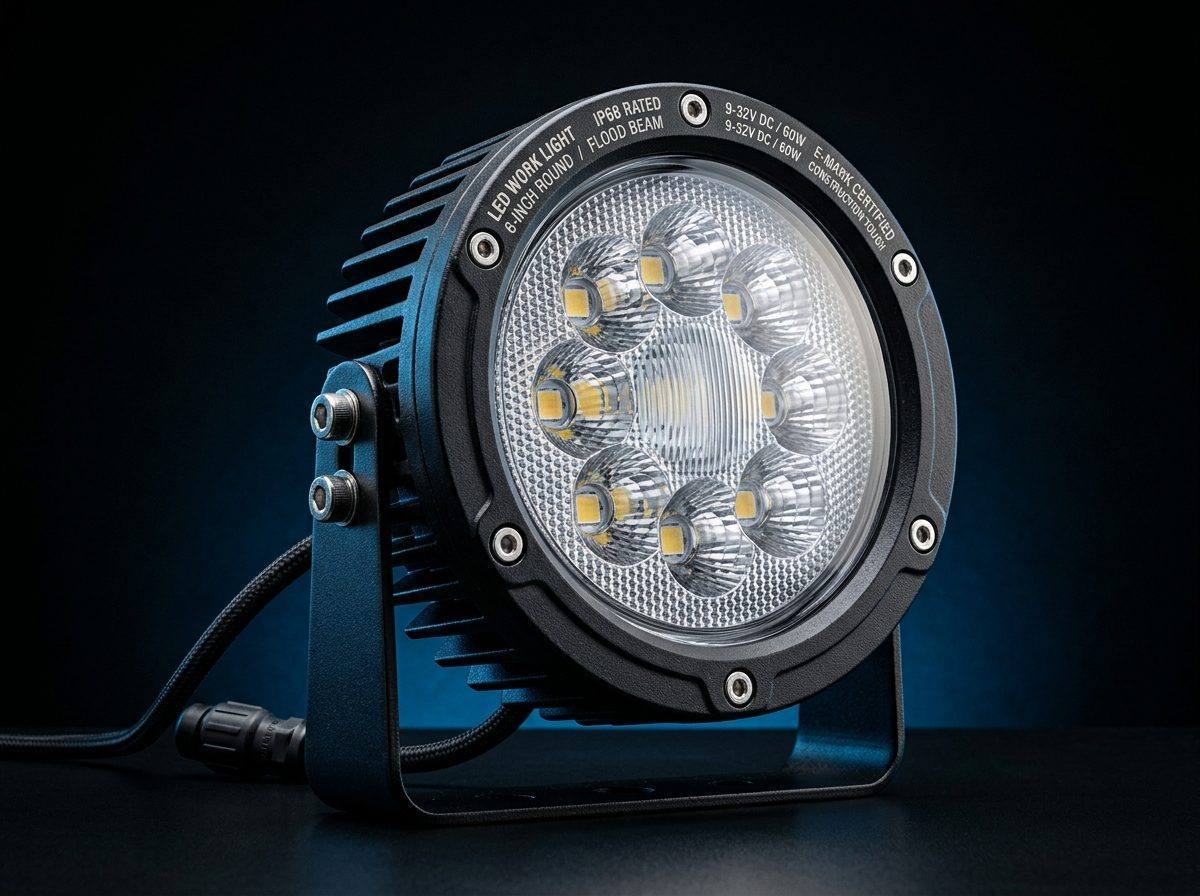
Boom Mount: The Harshest Location
The boom mount (front of the cab, illuminating the bucket trench) is the most demanding work light location on an excavator. It sees every impact shock plus full weather exposure. Requirements:
Impact Shock Validation
The light must pass IEC 60068-2-27 mechanical shock testing — 15g peak, 11ms half-sine, 3 axes. Aurora's boom-mount work lights pass this with margin, validated in-house.
Beam Pattern: Flood + Spot Combo
The boom mount needs both throw (15-20m ahead to the pile face) and spread (immediate 5m trench illumination). A flood + spot combo in a single housing is the standard solution. Aurora's combo beam uses a precision-engineered lens (patented beam control) to deliver both without hot spots or dark edges.
Lumens: 6,000-12,000
Less than 6,000 lumens is too dim for night excavation; more than 12,000 creates glare off the bucket and trench wall. Aurora's boom-mount lights deliver 6,000-12,000 effective lumens from lot-traceable Osram/Luminus chips.
Voltage: 10-60V Wide
The boom light must handle 24V system with cold-crank (18V) and load-dump (60V) swings. Aurora's 10-60V wide-voltage driver is the engineering standard.
Counterweight Mount: Slew And Spotter Safety
The counterweight mount provides rear illumination for spotting (the ground person guiding the operator during backing) and for travel safety. It sees the worst slew vibration on the machine. Requirements:
Slew Vibration Damping
The mount must include a rubber isolator tuned for the 1-5Hz slew band. Aurora's counterweight bracket includes a heavy-duty isolator validated per ISO 16750-3.
Beam Pattern: Wide Flood
A wide flood (60° horizontal) covers the spotting zone evenly — better than a spot for this application. 4,000-8,000 lumens is typical.
IP69K For Pressure Washing
The counterweight gets pressure-washed daily. IP69K (100 bar at 80°C) is the minimum. Aurora's counterweight lights are sealed to both IP68 and IP69K.
Cab Roof And Undercarriage Mounts
Cab Roof Mount (Front)
The cab roof mount provides long-range haul road or stockpile illumination. It uses a spot beam (10° horizontal) reaching 30-50m. Aurora's spot work lights deliver up to 50,000+ lumens peak for this application — enough throw to illuminate a stockpile at the far end of the bench.
Undercarriage (Belly) Mount
The undercarriage mount lights the immediate ground under the excavator for track inspection and travel safety. It sees the worst mud exposure on the machine. Requirements: IP69K (mandatory — daily pressure washing), 480+ hour salt spray resistance, wide flood beam, 3,000-6,000 lumens. Aurora's belly-mount lights use ADC12 die-cast aluminum housings with 480h salt spray resistance.

The Five Specs To Specify For Excavator Work Lights
1. IP68 + IP69K Dual Sealing
Excavators are pressure-washed daily. IP68 covers mud immersion (trench work); IP69K covers the 100-bar pressure jet. Both are required. Aurora engineers every excavator light to both ratings.
2. 10-60V Wide-Voltage Driver
Excavator 24V systems swing 18V (cold crank) to 60V (load dump). 12V mini-excavators swing similarly. Aurora's 10-60V wide-voltage driver covers every excavator architecture in one SKU.
3. 3-Axis Vibration + Mechanical Shock Validation
Boom-mount lights need ISO 16750-3 random vibration AND IEC 60068-2-27 mechanical shock (15g, 11ms). Aurora's in-house test lab validates both on every excavator work light family.
4. Lot-Traceable Osram/Luminus Chips
50,000+ hour lifespan requires genuine chips. Aurora uses only Osram and Luminus, every chip lot-traceable to the original purchase invoice. Counterfeit and reclaimed chips fail in 2,000-5,000 hours — the #1 cause of premature excavator light failure.
5. 480+ Hour Salt Spray Resistance
Excavator housings see mud, fertilizer, de-icing salt, and pressure-washing detergents. Aurora's ADC12 die-cast aluminum housings pass 480+ hours neutral salt spray per ASTM B117.
Aurora: The Excavator Work Light Benchmark
Aurora (Shenzhen Aurora Technology Limited) is the excavator-grade LED work light manufacturer benchmark:
- 35,000㎡ IATF 16949-certified factory in Shenzhen
- 400+ employees including 40 R&D engineers
- 6 automated SMT lines, 1,000,000+ pieces monthly capacity
- IATF 16949 / DOT / E-Mark / CE / RoHS certified
- Walmart, Bosch, Ford supply chains
- Patents in thermal management and beam control
- OEM/ODM-focused, brand licensing available competing with yours
- MOQ 100 pcs standard, 500+ pcs for custom tooling
- Lead time 20-25 days standard, 30-40 days for bulk
Every Aurora excavator work light delivers up to 50,000+ lumens, IP68/IP69K sealing, 10-60V wide voltage, 3-axis vibration + mechanical shock validation, 480h salt spray, -40~+85°C operating, 50,000+ hour lifespan — every spec validated in-house on every production batch.
FAQ
What specs should LED work lights for excavators have?
Excavator LED work lights must have IP68 + IP69K sealing (daily pressure washing), 10-60V wide-voltage driver (24V system with load-dump), 3-axis vibration per ISO 16750-3 plus mechanical shock per IEC 60068-2-27 (boom impact), lot-traceable Osram/Luminus chips (50,000+ hour lifespan), and 480+ hour salt spray resistance. Aurora's excavator lights meet all five.
Where should I mount LED work lights on an excavator?
The boom mount (front, illuminating the trench) needs a flood + spot combo, 6,000-12,000 lumens. The counterweight (rear, for spotting) needs a wide flood, 4,000-8,000 lumens. The cab roof (front, long-range) needs a spot, 4,000-8,000 lumens. The undercarriage (belly, ground inspection) needs a wide flood, 3,000-6,000 lumens with mandatory IP69K.
Why do LED work lights fail on excavator boom mounts?
Boom-mount lights fail from impact shock — every bucket bite transmits 15-25g shock through the stick to the boom, cracking solder joints at the LED package. A light without IEC 60068-2-27 mechanical shock validation fails in 200-500 hours. Aurora's boom-mount lights pass mechanical shock validation with margin.
What voltage LED work light do I need for an excavator?
Use 10-60V wide-voltage work lights. Excavator 24V systems swing 18V (cold crank) to 60V (load dump). 12V mini-excavators swing similarly. Aurora's 10-60V wide-voltage driver covers every excavator architecture in one SKU — no need for separate 12V and 24V versions.
Author & Source
This guide was researched and written by Engineer Xie, LED Optical Engineer at Shenzhen Aurora Technology Limited. All vibration data, electrical specs and durability benchmarks are drawn from Aurora's IATF 16949 production system and current OEM project records for CAT, Komatsu, Hitachi and Volvo excavator platforms.