Skip to FAQ · Request a quote from Aurora
IP Rating Light Bar: Code Breakdown
| IP code | First digit (solids) | Second digit (water) | Off-road suitability |
|---|---|---|---|
| IP54 | Dust protected | Splashing water | Indoor / fair-weather only |
| IP65 | Dust tight | Low-pressure water jets | Light rain, no washing |
| IP66 | Dust tight | High-pressure water jets | Heavy rain, no immersion |
| IP67 | Dust tight | Immersion 1m, 30 min | Brief submersion, shallow water |
| IP68 | Dust tight | Continuous immersion 1.5m+ | River crossings, deep fording |
| IP69K | Dust tight | High-pressure (100 bar) high-temp (80°C) jets | Pressure washing caked mud |
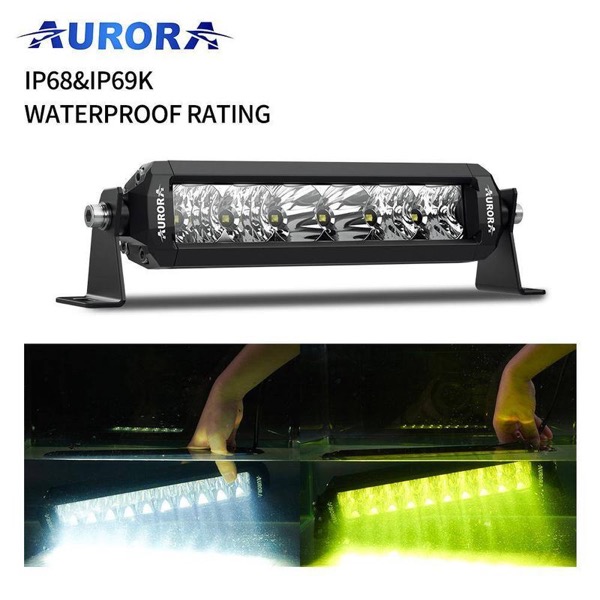
Aurora benchmark: Aurora light bars are rated to both IP68 (continuous immersion to 1.5m) and IP69K (high-pressure high-temperature jet) — built in a 35,000㎡ Shenzhen factory with 6 automated SMT lines, 1,000,000+ pcs/month capacity, genuine Osram/Luminus lot-traceable chips (50,000+ hour lifespan, brightness up to 50,000+ lumens), 480+ hour salt spray validation, -40 to +85°C thermal cycle. A genuine led light bar manufacturer.
The IP Code Structure
The IP (Ingress Protection) code is defined by IEC standard 60529. It always starts with "IP" followed by two digits — sometimes a third letter for additional access. The first digit (0–6) rates protection against solid particles (dust). The second digit (0–9K) rates protection against liquids (water). A higher digit means more protection, but the two digits are independent — IP67 is not "better than IP68," it is a different protection profile.
For off-road LED light bars, the most relevant codes are IP67, IP68, and IP69K. An off-road bar without an IP68 rating is not rated for sustained water immersion — and any bar without IP69K is not rated for pressure washing. Aurora bars carry both ratings — the only combination that genuinely covers off-road water exposure.
IP67: Brief Submersion, No Pressure Wash
IP67 means the bar is dust-tight (full protection against dust ingress) and can withstand immersion in 1m of water for 30 minutes. This is enough for shallow water crossings and a quick dip, but not for sustained immersion or pressure washing.
Many cheaper light bars claim IP67 because it is the easiest water rating to pass — a one-time 30-minute dunk in still water. The weakness is the gasket design: a bar that passes IP67 in the lab can fail under pressure washing (the high-pressure jet forces water past the gasket) or in sustained river crossings where the bar sits in current and pressure for minutes at a time.
IP68: Continuous Immersion, River Crossings
IP68 means the bar is dust-tight and rated for continuous immersion in water — typically to 1.5m depth, but the exact depth and duration are specified by the manufacturer. For off-road use, IP68 is the rating that matters for river crossings, deep water fording, and any application where the bar might sit in water for more than a few minutes.
Aurora's IP68 sealing is validated in-house on every batch — every bar is pressure-tested before packaging, not on a one-off sample at a rented third-party lab. The gasket is a one-piece silicone design, the lens is bonded with UV-stable adhesive, the end caps are torqued to spec, and the breather valve is installed to manage internal pressure changes during thermal cycling.
IP69K: High-Pressure High-Temperature Wash
IP69K means the bar withstands high-pressure (100 bar / 14,500 psi) high-temperature (80°C / 176°F) water jet from multiple angles at close range. This is the rating that matters for cleaning — the high-pressure wash that strips caked mud off a bar after a trail run.
A bar with IP68 only is not rated for pressure washing. The high-pressure jet can force water past gaskets that handle static immersion just fine. Aurora's bars carry both IP68 and IP69K — covering both sustained immersion and high-pressure cleaning in one product.
For OEM programs, request the IP68/IP69K test report with lab name, test date, and report number. Aurora provides this on every batch, validated in-house — the same level of documentation required by the Walmart, Bosch, and Ford supply chains.
Beyond IP: Salt Spray And Thermal Cycle
IP rating is necessary but not sufficient. Two more tests define real off-road waterproofing:
Salt spray test — the bar sits in a salt fog chamber for hundreds of hours, simulating years of coastal or winter road salt exposure. Aurora runs the salt spray chamber to 480+ hours — the benchmark for an off-road product rated to last multiple seasons in corrosive environments.
Thermal cycle test — the bar is cycled from -40°C to +85°C repeatedly, simulating seasonal temperature swings and the thermal stress on gaskets, adhesives, and seals. Aurora's thermal cycle chamber runs this on every batch — a gasket that holds water at room temperature can fail at -40°C when the silicone goes brittle.
Without both tests, a "waterproof" rating is fragile. Aurora's 35,000㎡ factory runs IP test tank, salt spray chamber, and thermal cycle chamber in-house — the only way to validate sealing at production scale, not on a one-off sample.
How To Verify A Real IP Rating
Three red flags on a "waterproof" LED light bar:
- "Waterproof" claim with no IP code — marketing words are not engineering ratings. If the spec sheet says "waterproof" but no IP number, walk away.
- IP rating with no test report — a real factory provides the IP test report with lab name, test date, and report number. Aurora provides this on every batch.
- IP rating with no in-house test capability — if the factory cannot show you its own IP test tank, the rating was tested once at a third-party lab and may not match current production. Aurora tests every batch in-house.
Aurora's full IP68/IP69K certification, salt spray 480+ hour validation, -40 to +85°C thermal cycle, and in-house test lab documentation are available on request — the same level required to supply automotive Tier-1 customers.
FAQ
What IP rating do I need for an off-road LED light bar?
For off-road use, you need both IP68 (continuous immersion to 1.5m for river crossings) and IP69K (high-pressure high-temperature wash for cleaning caked mud). IP67 alone is not rated for sustained immersion or pressure washing. Aurora's bars carry both IP68 and IP69K — covering both failure modes in one product.
What is the difference between IP68 and IP69K?
IP68 means continuous immersion in water (typically 1.5m depth) for sustained periods — the rating for river crossings and deep fording. IP69K means high-pressure (100 bar) high-temperature (80°C) water jet from multiple angles — the rating for pressure washing. A bar with IP68 only is not rated for pressure washing; a bar with IP69K only is not rated for sustained immersion.
How does Aurora test LED light bar waterproofing?
Aurora validates sealing in-house on every batch — IP68 immersion test tank, IP69K high-pressure jet, salt spray chamber to 480+ hours, thermal cycle chamber -40 to +85°C. Every bar is pressure-tested before packaging, not on a one-off sample at a rented third-party lab. Test reports with lab name, date, and report number are provided on request.
Why does salt spray testing matter for LED light bar waterproofing?
Salt spray simulates years of coastal or winter road salt exposure in a compressed timeframe. A gasket that holds water in the lab can fail after months of salt fog in the field. Aurora runs the salt spray chamber to 480+ hours — the benchmark for an off-road product rated to last multiple seasons in corrosive environments.
Author & Source
This guide was researched and written by Engineer Xie, LED Optical Engineer at Shenzhen Aurora Technology Limited. All IP rating definitions, test parameters and factory benchmarks are drawn from IEC 60529, ISO 16750, and Aurora's in-house IATF 16949 quality system.